Not registered yet? Please contact our project manager Sonja Leissner . This area is only for members of the research consortium.

News

3 March 2026

Tiny Messengers, Big Impact: Large Extracellular Vesicles in Acute Liver Decompensation

Acute decompensation (AD) of cirrhosis marks a critical turning point in advanced liver disease and is associated with high short-term mortality. Identifying which patients are at greatest risk within the first 90 days remains a major clinical challenge, as existing scoring systems do not fully capture the biological complexity underlying rapid deterioration.
In our latest video, we present findings from the DECISION project investigating Large Extracellular Vesicles (lEVs), circulating particles released by stressed or damaged cells that carry molecular information about ongoing disease processes.

By analyzing the protein cargo of lEVs in patients with acute decompensation, we identified a distinct three-protein signature derived from the liver, immune system, and kidney that was strongly associated with mortality. Importantly, integrating these molecular markers into the established CLIF-C AD score significantly improved its predictive performance for 90-day mortality.

These results highlight the potential of combining clinical scoring systems with molecular biomarkers to refine risk stratification and support earlier, more targeted clinical decision-making in advanced liver disease.
📖 Keep an eye out for the publication!
🎥 Watch the full video

More news

News

24 February 2026

Emergency Granulopoiesis in Liver Failure: When the Immune System Goes into Chaos

In this video, we explore how emergency granulopoiesis, the rapid production of immune cells during crisis, becomes defective in acute liver failure. Using the analogy of a fire station releasing firefighters, Ferran Aguilar, biostatistician and first author of the accompanying paper, illustrates how the body’s emergency response can spiral into a vicious cycle: liver injury triggers immune chaos, which in turn fuels further damage.

Our findings reveal that this is not simply an exaggerated immune response. Instead, the immune “factory” begins producing the wrong cells at the wrong time, contributing to disease progression.

Understanding this defective emergency program opens the door to new therapeutic strategies, not to suppress the immune system, but to help it generate the right response when it is needed most.

🎥 Watch the full video:

📖 Read the publication Maladaptive emergency granulopoiesis predicts poor outcomes in patients hospitalized with decompensated cirrhosis.

More news

Events

13 October 2025

DECISION’s final General Assembly Meeting in Madrid

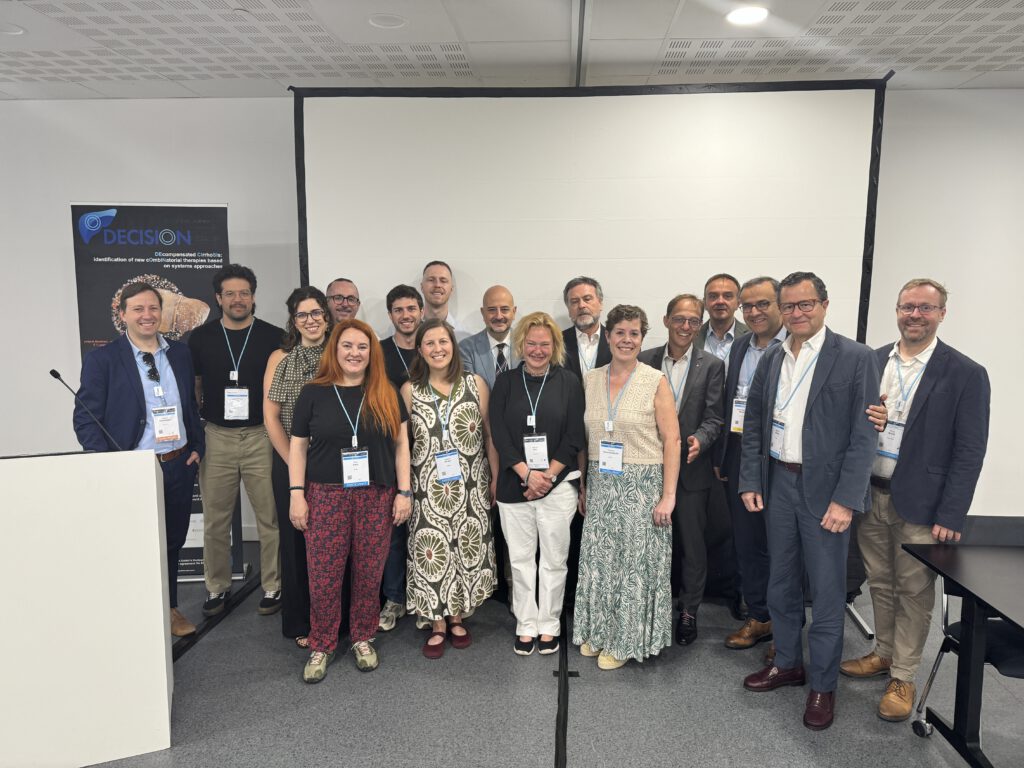
The DECISION consortium headed to Madrid for our final General Assembly Meeting. Although the project continues for a few more months, coming together in person felt like closing an important chapter and reflecting on five years of collaborative work.

The first day focused on the past, present, and future of DECISION’s science. We revisited key aspects from our multi-omic analyses, explored upcoming publications, and looked ahead to future data integration and systems-level insights. The day concluded with a practical masterclass on data repositories and publication rights.

On the second day, we aligned on progress in our COMBAT and PROSPECT clinical studies and discussed upcoming analysis plans. A consortium-wide conversation on what may follow after DECISION highlighted ongoing enthusiasm and opportunities for continued collaboration.

We leave Madrid proud of our collective achievements and committed to delivering our final results in the months ahead.

More events

Our Vision

DECISION strives to better understand the pathophysiology of decompensated cirrhosis leading to acute-on-chronic liver failure (ACLF) at the systems level by taking advantage of already existing large and clinically well characterized patient cohorts. The ultimate goal is to significantly reduce mortality through combinatorial therapies that are tailored to the specific needs of individual patients. Part of this endeavour is to develop a reliable prognostic test and a robust response test.

Learn more

Why it matters

In 2013, cirrhosis was responsible for 1.2 million deaths worldwide. While most cirrhosis patients initially do not show symptoms, acute decompensation of cirrhosis, defined as the body’s inability to cope with the progressing dysfunctionality of the liver, leads to drastic symptoms. Decompensation is characterized by the development of ascites, hepatic encephalopathy, jaundice, or gastrointestinal haemorrhage, and is often a turning point for cirrhosis.

Learn more